





Sustainable housing adoption in Ethiopia is often discussed through a narrow lens of affordability, with the dominant assumption being that lowering housing costs will automatically increase adoption. However, this view overlooks how housing decisions are actually made, especially in rapidly urbanising contexts such as Ethiopia.
In practice, sustainable housing adoption is not shaped by price alone; it is influenced by values, institutions, and everyday lived realities. Understanding these deeper drivers is essential if housing policies are to move from good intentions to real outcomes.
In Ethiopia, the challenge of sustainable housing adoption is particularly acute. Rapid urban growth, limited access to land, weak housing finance systems, and uneven infrastructure have created structural barriers that affect large segments of the population. Civil servants sit at the centre of this challenge.
They are a stable, policy-relevant group, yet many struggle to secure adequate and sustainable housing. For Muslim civil servants, housing choices are further shaped by religious considerations, especially the limited availability of Shariah-compliant housing finance. These realities are rarely captured in mainstream housing debates or policy frameworks.
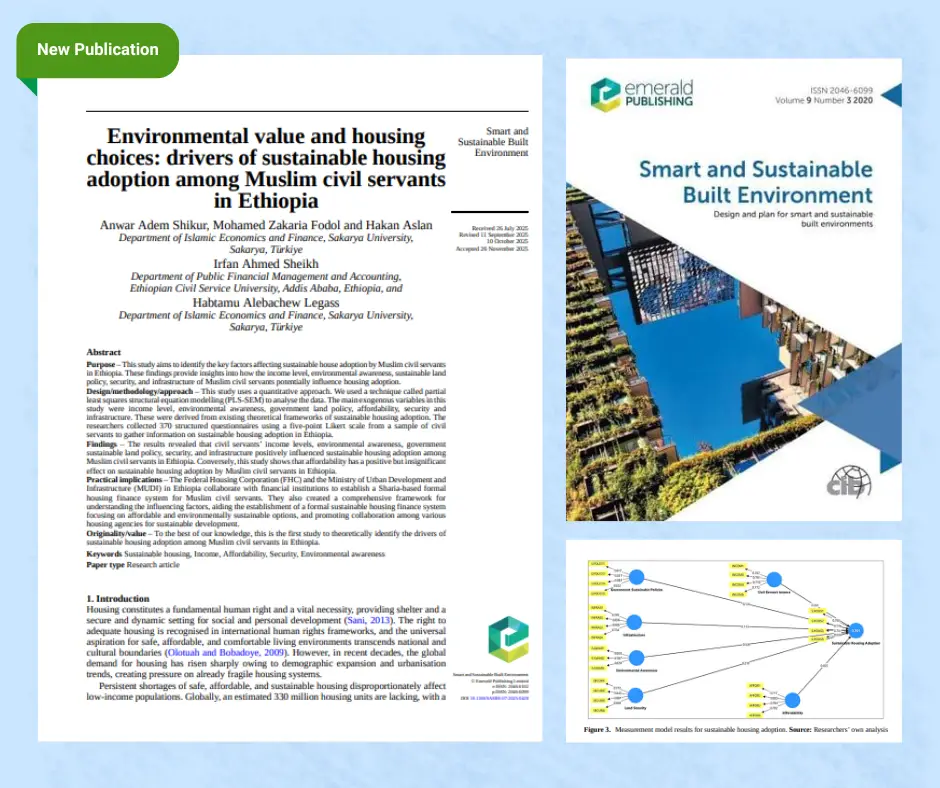
This blog post is informed by our newly published paper in Smart and Sustainable Built Environment, which examines sustainable housing adoption in Ethiopia through the lived experiences of Muslim civil servants. Using empirical evidence, the study challenges a common policy narrative: affordability, while important, is not the main factor driving adoption.
Instead, environmental awareness, income stability, government land policies, housing security, and infrastructure quality play a stronger and more consistent role. In other words, people are more likely to adopt sustainable housing when they trust the system, feel secure in their tenure, understand the environmental value of their choices, and have access to basic services.
These findings matter beyond Ethiopia. Across Africa, sustainable housing policies often focus narrowly on cost reduction while neglecting governance, awareness, and financing structures.
This article has moved beyond description to offer evidence-based insight from our newly published study. It showed how environmental awareness influences housing choices, how housing security and infrastructure shape long-term investment decisions, and why Islamic finance is essential for sustainable housing adoption among Muslim communities.
Together, these findings contribute to the broader debate on sustainable housing in Africa and underline a key policy lesson: “effective housing strategies must go beyond affordability to address the full ecosystem that drives housing adoption.
Sustainable Housing Adoption in Ethiopia: Looking Beyond Price
Housing discussions in Ethiopia, as in much of Africa, often revolve around one idea”, which is affordability. The logic seems straightforward, if housing is cheaper, people will adopt it.
However, findings from our newly published study show that this assumption is incomplete. In reality, sustainable housing adoption in Ethiopia is shaped by a wider set of factors that go well beyond cost.
In simple terms, sustainable housing refers to homes that are environmentally efficient, durable, healthy to live in, and economically viable over the long run. This includes energy-saving designs, efficient water use, good construction quality, and access to basic services. Adoption, therefore, is not just about owning a house, but about choosing a housing option that improves long-term living conditions.
Our empirical study, based on survey data from Muslim civil servants in Ethiopia and published in Smart and Sustainable Built Environment, confirms that people do not adopt sustainable housing simply because it is affordable. Instead, they adopt it when the broader system, awareness, security, infrastructure, and financing, makes that choice reasonable and safe.
Awareness Changes Housing Choices
One of the strongest findings of the study relates to environmental awareness. Environmental awareness means understanding how housing affects energy bills, water use, indoor comfort, and long-term maintenance costs.
The results show that environmental awareness has a positive and statistically significant effect on sustainable housing adoption.
In practical terms, respondents who understood the environmental and long-term benefits of sustainable housing were far more likely to support or choose it.
To make this clearer, environmental awareness influences housing choice in several ways:
- It helps households see housing as a long-term investment, not just a shelter.
- It links sustainability with lower future expenses, such as electricity and maintenance costs.
- It connects housing decisions to health and comfort, especially ventilation and indoor air quality.
These finding matters because awareness can be improved through policy, education, and public communication. Unlike income, which is slow to change, awareness is a policy-lever that governments can actively influence.
Income Helps, But It Is Not Everything
Income does matter, but not in the way many policymakers assume. Our findings show that income has a positive and significant relationship with sustainable housing adoption. Higher-income civil servants are more likely to consider sustainable housing options because they can absorb initial costs and think long-term.
However, income alone does not explain adoption. Many respondents with stable income still avoided sustainable housing when other conditions were missing, especially housing security and suitable financing. This helps explain why affordability, as a standalone variable, did not emerge as a decisive factor in the model.
In short:
- Income enables choice
- But does not guarantee adoption
Why Security Comes First
Housing security refers to the stability of one’s living situation, secure tenure, clear land rights, and protection from eviction. Without this security, investing in sustainability makes little sense.
The study finds that housing security has a strong and statistically significant impact on sustainable housing adoption. Respondents who felt secure in their housing arrangements were much more willing to invest in durable materials, efficient designs, and long-term housing solutions.
This relationship is intuitive. People are unlikely to invest in sustainability if they fear losing their home or land. For Muslim civil servants, housing security is also closely linked to family stability and social responsibility, reinforcing its importance.
Infrastructure Makes Sustainability Possible
Sustainable housing cannot function in isolation. It depends heavily on basic infrastructure, such as:
- Reliable electricity
- Clean water supply
- Sanitation systems
- Roads and access to services
The empirical results show that infrastructure availability significantly increases the likelihood of sustainable housing adoption. Where infrastructure is weak or unreliable, sustainable housing loses much of its practical value.
For example:
- Energy-efficient homes make little sense without stable electricity.
- Water-saving systems fail without reliable water access.
This finding highlights a major policy gap. Housing programs that deliver units without infrastructure integration are unlikely to achieve sustainability goals.
The Surprising Result: Affordability Was Not Decisive
Perhaps the most policy-relevant finding of the study is this: affordability was statistically insignificant in explaining sustainable housing adoption among Muslim civil servants.
This does not mean housing costs are irrelevant. Rather, it means that cost alone does not determine behaviour. Several factors help explain this result:
- Housing scarcity pushes prices up across the board, making “affordable” options rare.
- Lack of suitable financing prevents households from acting even when prices are manageable.
- Risk considerations lead households to prioritise security and infrastructure over price.
This challenges the dominant housing narrative and suggests that affordability-focused policies, on their own, are unlikely to deliver sustainable outcomes.
The Missing Piece: Islamic Finance
A critical contribution of the study lies in highlighting the role of Islamic finance and housing. Many Muslim civil servants avoid conventional mortgages due to interest (riba), even when such loans are available.
As a result:
- Housing may be affordable in theory
- But financially inaccessible in practice
The absence of Shariah-compliant housing finance options weakens adoption and reduces the effectiveness of housing policies. Islamic finance tools, such as asset-based financing, cooperative housing schemes, or Islamic microfinance, can bridge this gap.
From an Islamic finance perspective, sustainable housing aligns naturally with:
- Long-term asset ownership
- Risk-sharing principles
- Social and environmental responsibility
Integrating Islamic finance into affordable and sustainable housing policy would significantly expand access and trust among Muslim communities.
Lessons for Sustainable Housing in Africa
While the study focuses on Ethiopia, its implications extend across Africa. Sustainable housing in Africa faces similar challenges: rapid urbanisation, weak institutions, infrastructure gaps, and limited access to inclusive finance.
The evidence from sustainable housing adoption in Ethiopia suggests a clear lesson: housing policy must address the full ecosystem, not just prices.
Environmental awareness, housing security, infrastructure provision, and inclusive financing, especially Islamic finance, are not secondary issues. They are central to whether sustainable housing is adopted or ignored.
What Should Change, and How?
The evidence from sustainable housing adoption in Ethiopia sends a clear message to policymakers: housing policy cannot succeed by focusing on affordability alone.
While cost remains an important concern, it is not the decisive factor shaping adoption. People adopt sustainable housing when the broader system supports long-term, secure, and meaningful housing choices.
- First, environmental awareness must be treated as a core policy tool, not a side benefit. Public awareness campaigns, sustainability standards for public housing, and integration of environmental education into urban policy can significantly influence housing behaviour at relatively low cost. When households understand the long-term economic and health benefits of sustainable housing, adoption follows.
- Second, housing security and land governance require urgent attention. Secure tenure, transparent land allocation, and predictable housing regulations create the confidence needed for long-term investment. Without this foundation, sustainability incentives—financial or otherwise—will continue to underperform.
- Third, infrastructure investment must move in parallel with housing delivery. Sustainable housing is only viable when supported by reliable electricity, water, sanitation, and transport systems. Housing programs that ignore infrastructure realities risk producing units that are neither sustainable nor desirable.
- Finally, and most critically for Muslim communities, Islamic finance must be integrated into housing policy frameworks. The absence of Shariah-compliant housing finance explains why affordability alone does not translate into adoption. Expanding Islamic housing finance instruments—through partnerships with Islamic banks, cooperatives, and public housing agencies—would unlock demand, improve inclusivity, and align housing policy with social values.
In sum, the policy lesson is straightforward but often overlooked: sustainable housing adoption is systemic. It depends on awareness, security, infrastructure, and appropriate finance working together. Ethiopia’s experience shows that when policy moves beyond price and addresses this full ecosystem, sustainable housing becomes not just an aspiration, but a realistic and scalable outcome, for Ethiopia and for Africa more broadly.
- Explore my publications from here